Ute canopy vs service body: which is better for Australian tradies?
For Australian electricians, plumbers, builders and mobile service businesses, choosing between a ute canopy and a service body is a decision worth getting right. Not because one option is necessarily better, but because the wrong setup can become frustrating when you're using it five or six days a week.
In short
- A canopy is generally an enclosure over a tub or tray, while a service body is a more integrated, work-focused storage arrangement - but the terms overlap.
- Choose around the work you actually do and the equipment you carry, including the large items.
- Everyday access matters as much as storage capacity. Check doors and drawers open where you normally park.
- Canopies, service bodies and accessories all add weight. Check GVM, axle limits and load restraint.
- Compare complete quotes, including accessories, installation and any certification requirements.
You’ve decided it’s time to get your work ute properly organised.
The tools are piling up, you’re running out of secure storage, and you’re getting tired of moving things around every time you need something from the back.
A canopy sounds like the answer.
Then you start looking at service bodies.
One looks like a large enclosed storage area. Another has separate compartments, side-opening doors and drawers. Some sit on an existing tray, while others replace the entire rear body of the ute.
And just when you think you’ve worked out the difference, you discover that some manufacturers use the terms canopy and service body for almost the same thing.
So which one should you choose?
For Australian electricians, plumbers, builders and mobile service businesses, it’s a decision worth getting right. Not because one option is necessarily better, but because the wrong setup can become frustrating when you’re using it five or six days a week.
Before spending your money, here’s what you need to know.
First, what’s the actual difference?
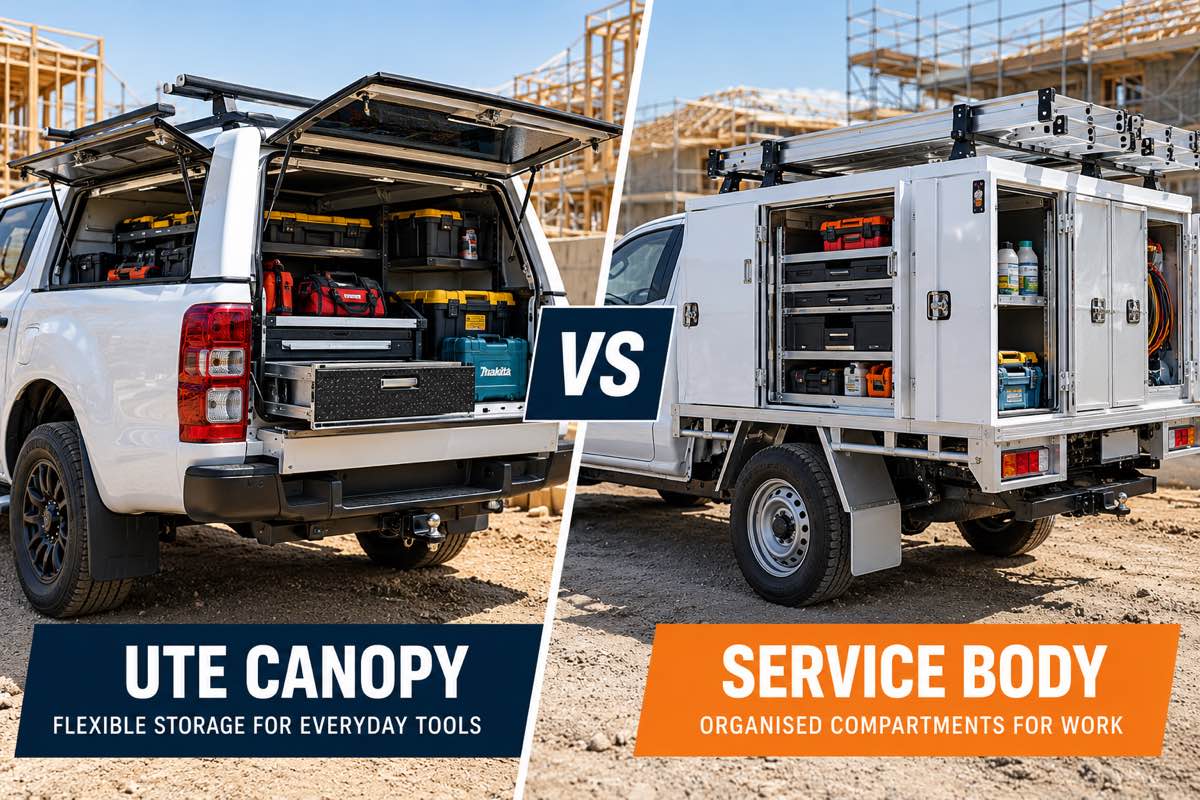
The simplest way to understand it is to look at how the storage is built and what it’s designed to do.
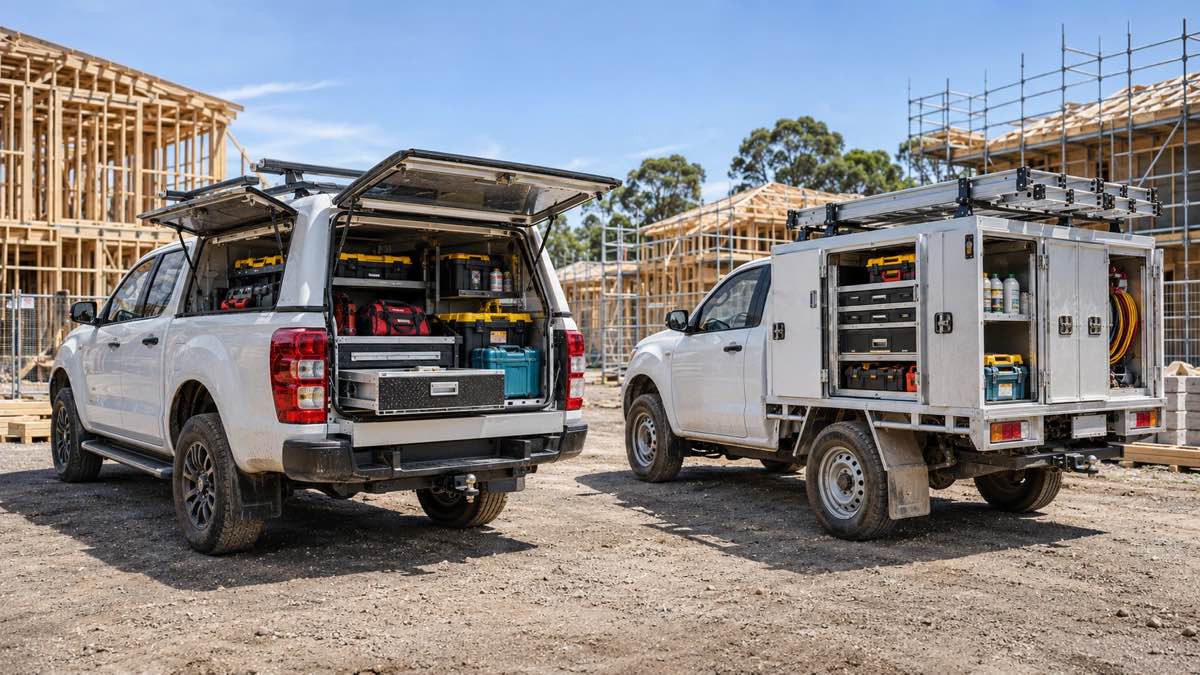
A ute canopy is generally an enclosed storage structure fitted over an existing ute tub or mounted onto a tray.
Some are straightforward enclosures that keep equipment covered. Others are designed for commercial use, with lifting side doors, internal shelving, drawers and lockable compartments.
A service body is generally a more integrated work-focused storage arrangement. It may have multiple compartments, dedicated tool storage and access points designed around the equipment a tradesperson carries.
Some service bodies are mounted directly to a suitable vehicle chassis, replacing the original tub or tray arrangement. Others use a tray-based design.
The confusing part is that these descriptions overlap.
You can buy a commercial canopy with almost everything you’d expect in a service body. You can also find service bodies with large open storage areas instead of individual compartments.
That’s why it’s worth looking beyond the product name.
What matters is how the finished vehicle will function.
Will your tools fit? Can you reach them easily? Is the body suitable for the vehicle? And how much carrying capacity will remain once everything is installed?
Those are the questions that should guide the decision.
Start with the work you actually do
Imagine two tradies driving the same dual-cab ute.
One is an electrician doing residential maintenance. Most days involve hand tools, testing equipment, cable accessories and a collection of small fittings.
The other is a carpenter moving between building sites with saws, power tools, equipment cases and different materials depending on the job.
They might have identical vehicles, but their storage needs are very different.
The electrician may appreciate dedicated compartments, drawers and easy access to smaller equipment.
The carpenter might find those same compartments restrictive, particularly when trying to carry bulky tools or larger materials.
A relatively open canopy could be more practical for the carpenter, while a service body with organised storage might better suit the electrician.
Of course, there’s no fixed rule.
An electrician undertaking major commercial installations may need more open cargo space than someone handling maintenance calls.
Likewise, a carpenter who carries a consistent collection of tools may benefit from a carefully organised service body.
The trade matters, but the type of work matters more.
Before choosing anything, make a list of the equipment you carry during an ordinary working week.
Include the large items, not just the tools that fit neatly inside a drawer.
Think about what stays in the vehicle permanently and what changes from job to job.
You’ll quickly get a clearer picture of how much open space you need and how much dedicated storage would actually be useful.
The difference you’ll notice every morning: access
Storage capacity is important, but getting to your equipment is just as important.
Picture yourself parked in a customer’s driveway.
You need a particular power tool, but it’s at the back of the ute, behind two equipment cases and a container of fittings.
You move everything out of the way, retrieve the tool and then put it all back.
It’s annoying, but manageable.
Now imagine doing it several times a day.
That’s where storage layout starts to matter.
Some canopies have rear and side openings, allowing you to reach different areas of the cargo space.
Service bodies often have separate compartments with individual doors, which can make it easier to organise equipment by purpose.
But neither arrangement guarantees convenient access.
A large lifting door might be difficult to open when you’re parked close to a wall. A drawer might not extend properly if there isn’t enough clearance beside the vehicle.
Even the height of a compartment can make a difference when you’re retrieving heavy equipment.
Before ordering, picture where you normally park and how you work.
- Do you usually stand beside the ute or access equipment from the rear?
- Do you need to reach small parts several times during a job?
- Are you regularly loading bulky machinery?
- And can you open every compartment comfortably when the vehicle is parked in a typical driveway or worksite?
An enclosure might look impressive in a showroom, but it’s the everyday access that determines whether you’ll enjoy using it.
Think carefully about how much open space you need
One of the biggest differences between storage layouts is the amount of uninterrupted space they provide.
For some tradies, dedicated compartments are extremely useful.
A mobile service technician carrying spare parts, hand tools and diagnostic equipment may prefer everything separated and clearly organised.
For others, too many compartments can become a problem.
A plumber who occasionally carries a large drain-cleaning machine might need a wide opening and sufficient room to load it.
A builder may need space for different-sized equipment cases or materials that change from one job to the next.
A heavily compartmentalised body might offer excellent organisation but leave limited space for those larger items.
On the other hand, a completely open canopy can be frustrating if everything ends up stacked on top of everything else.
The solution may be a combination.
You might want dedicated storage along one side, drawers for smaller tools and an open section for bulkier equipment.
The point is to plan around the largest items as well as the things you use most often.
There’s little benefit in having twenty perfectly organised compartments if the equipment you need tomorrow won’t fit inside the vehicle.
Don’t forget about the weight
Here’s something that can catch people out.
A ute may have plenty of storage space and still be close to its permitted weight limit.
Canopies, service bodies, drawers, roof racks, toolboxes and electrical accessories all add weight.
So do the driver, passengers, tools and materials.
Your vehicle’s Gross Vehicle Mass (GVM) is the maximum permitted mass of the fully loaded vehicle. Every accessory you install uses some of the capacity that would otherwise be available for carrying equipment.
The front and rear axle load limits also need to be respected.
It’s tempting to assume that aluminium equipment will always be lightweight, but the actual weight depends on the design, construction and accessories.
A simple aluminium canopy could be lighter than a fully equipped service body.
But a canopy with extensive drawers, shelving, batteries and roof-mounted equipment might weigh more than a relatively simple integrated body.
You need to compare the complete installations, not just the basic enclosures.
Ask for the weight of the proposed setup, including the accessories you’ve selected.
Then consider what the ute normally carries on a working day.
Where necessary, have the vehicle weighed to establish its actual loaded mass and axle loads.
A lockable compartment doesn’t automatically mean a safely secured load
Tools and equipment also need to be appropriately restrained during transport.
The National Transport Commission’s Load Restraint Guide for Light Vehicles explains the load restraint requirements for light vehicles, including utes with a GVM of up to 4.5 tonnes.
A toolbox sitting inside a canopy isn’t necessarily secure simply because the door is locked.
Storage mountings, compartments and any additional restraints must be suitable for the loads being carried.
The same applies to ladders and equipment transported on roof racks.
A well-organised vehicle is useful. A safely loaded vehicle is essential.
What about security and weather protection?
For many tradies, the ute carries equipment worth a considerable amount of money.
Losing a collection of power tools, testing instruments or specialist equipment can be expensive and disruptive.
Both canopies and service bodies can provide lockable storage, but the level of security depends on the particular product.
Look at the door construction, locks, hinges and how the compartments are secured.
Some canopies have windows, which may be convenient in certain situations but can leave stored equipment visible from outside.
Solid-sided enclosures and individual lockable compartments can offer more privacy.
Still, no enclosure should be considered completely theft-proof.
Weather protection deserves attention as well.
An enclosed body can help protect equipment from rain, dust and road spray, but the effectiveness depends on the seals, design, drainage and installation.
If you regularly travel on unsealed roads, ask about dust protection.
If you’re carrying sensitive equipment, think about the temperature and ventilation inside the storage area.
It’s also worth considering how water might enter when doors are opened during heavy rain.
The most suitable enclosure is one that protects your equipment under the conditions in which you actually work.
Which is better for different trades?
There isn’t one answer that suits everyone, but these examples can help narrow down the options.
Electricians
Electricians often carry a mixture of hand tools, testing equipment, power tools and small fittings.
A service body with separate compartments can make those items easier to organise.
A canopy with well-designed drawers and shelving could work just as well.
The deciding factor is whether enough space remains for larger tools, cable and job-specific materials.
Plumbers
Plumbing work can involve everything from small fittings and hand tools to bulky machines and long materials.
A plumber doing routine maintenance might appreciate dedicated compartments for fittings and tools.
Someone regularly carrying larger equipment may value a more open storage arrangement.
It’s important to consider how larger items will be loaded and secured, not just where the smaller tools will go.
Builders and carpenters
Builders and carpenters often carry equipment that changes depending on the job.
Open storage space can be valuable when transporting larger power tools, equipment cases and suitable materials.
A canopy with flexible internal storage may be practical.
However, a well-planned service body can also work, particularly when the tools being carried are relatively consistent.
Mobile mechanics and service technicians
For businesses that carry a regular selection of tools, spare parts and specialist equipment, organised compartments can make daily work easier.
A service body may provide useful separation between different equipment types.
But accessibility, equipment weight and the space needed for larger items still matter.
Fleet operators
Businesses running several work vehicles may benefit from consistent storage layouts.
When equipment is kept in familiar locations, employees can move between vehicles more easily.
That doesn’t mean every vehicle needs an identical setup.
A maintenance vehicle may require different storage from an installation vehicle, even within the same business.
The most effective arrangement is one that matches the job each vehicle performs.
Is a service body more expensive than a canopy?
Often, a simple canopy will cost less than a fully equipped commercial service body.
But it isn’t always a fair comparison.
One quote might cover a basic canopy and installation.
Another may include a service body with internal compartments, drawers, locks and other storage already incorporated.
Once you add the accessories required to make the canopy suitable for commercial work, the difference in price may change considerably.
There are also different mounting arrangements to consider.
A canopy fitted to an existing tub is a different proposition from a tray-mounted canopy or a complete replacement service body.
Depending on the vehicle and design, the work may involve removing an existing tub, fitting a suitable tray, arranging mounting hardware or completing other vehicle modifications.
Some modifications may also require certification or approval under the applicable state or territory requirements.
Before accepting a quote, make sure you understand the complete cost.
Ask what’s included, which accessories are extra and whether the quoted installation covers everything required for your vehicle.
And don’t forget to ask about the warranty and after-sales support.
A cheaper setup that doesn’t suit the job may turn out to be a frustrating purchase.
But there’s no reason to pay for expensive compartments and accessories you’ll never use.
Good value comes from choosing the right arrangement, not simply the lowest price.
Five things I’d check before making a decision
If you’re still deciding, here’s a practical way to narrow it down.
- Write down what you actually carry. Include everyday tools, larger equipment, consumables and materials. Measure the bulky items rather than guessing whether they’ll fit.
- Think about how you access your equipment. Which side of the ute do you normally work from? What do you retrieve most often? Will the proposed doors and drawers open properly where you normally park?
- Check the vehicle’s carrying capacity. Find out the complete installed weight of the body and accessories. Consider the weight of your normal load and the vehicle’s mass and axle limits.
- Compare complete quotes. Look at the enclosure, storage, locks, mounting, installation, accessories and any certification requirements. Make sure you’re comparing equivalent setups.
- Leave some room for the business to change. Think about whether you’ll be carrying different equipment in a year or two. A little flexibility can make future adjustments easier.
You don’t need to become an expert in vehicle body design.
But having clear answers to these questions will make it much easier to explain what you need and compare the available options.
So, which one should you choose?
If you regularly carry larger equipment and need flexibility, an open or partly compartmentalised canopy could make more sense.
If you carry a consistent range of tools and parts and want dedicated storage that’s accessible throughout the day, a service body may be a better fit.
But the names alone won’t tell you enough.
A well-designed commercial canopy may offer much the same functionality as a service body, while two service bodies can have completely different layouts.
Before you decide, think about the jobs you actually do, the equipment you carry and how you’ll use the vehicle once it’s fitted out.
It’s worth spending a little longer planning rather than discovering later that your most expensive tools are difficult to reach or that your largest equipment case no longer fits.
After all, you’re not buying a canopy or service body just to make your ute look better.
You’re buying something you’ll depend on every working day.
The best setup is the one that helps you open the right compartment, grab what you need and get on with the job.
About the author
Anthony Nazari is Founder and Sales Manager at Fleet Fitout, a Sydney-based business specialising in commercial van and ute fitouts, canopies, service bodies, shelving and vehicle storage solutions for Australian tradespeople and businesses.
Common questions
What is the difference between a ute canopy and a service body?
A ute canopy is generally an enclosed storage structure fitted over an existing ute tub or mounted onto a tray. A service body is generally a more integrated, work-focused storage arrangement with compartments and access points designed around the equipment a tradesperson carries. The terms overlap, so look at how the finished vehicle will function.
Is a service body more expensive than a canopy?
Often, a simple canopy will cost less than a fully equipped commercial service body. But once you add the accessories needed to make a canopy suitable for commercial work, the difference in price may change considerably. Compare complete quotes, including installation and any certification.
Which is better for electricians, plumbers or carpenters?
There’s no fixed rule. Electricians and mobile technicians often benefit from organised compartments, while carpenters and builders may need more open space for bulky tools and materials. The type of work matters more than the trade.
Does a canopy or service body affect how much my ute can carry?
Yes. Canopies, service bodies, drawers, roof racks and accessories all add weight and use some of the vehicle’s capacity within its Gross Vehicle Mass (GVM). Ask for the weight of the complete installation, and consider the front and rear axle limits.