5 work vehicle setup mistakes that cost Australian tradies time and money
For electricians, plumbers, carpenters and mobile service technicians, a work vehicle is much more than a way to get from one job to another. Getting the setup right starts with understanding what you carry, what you use most often and what slows you down.
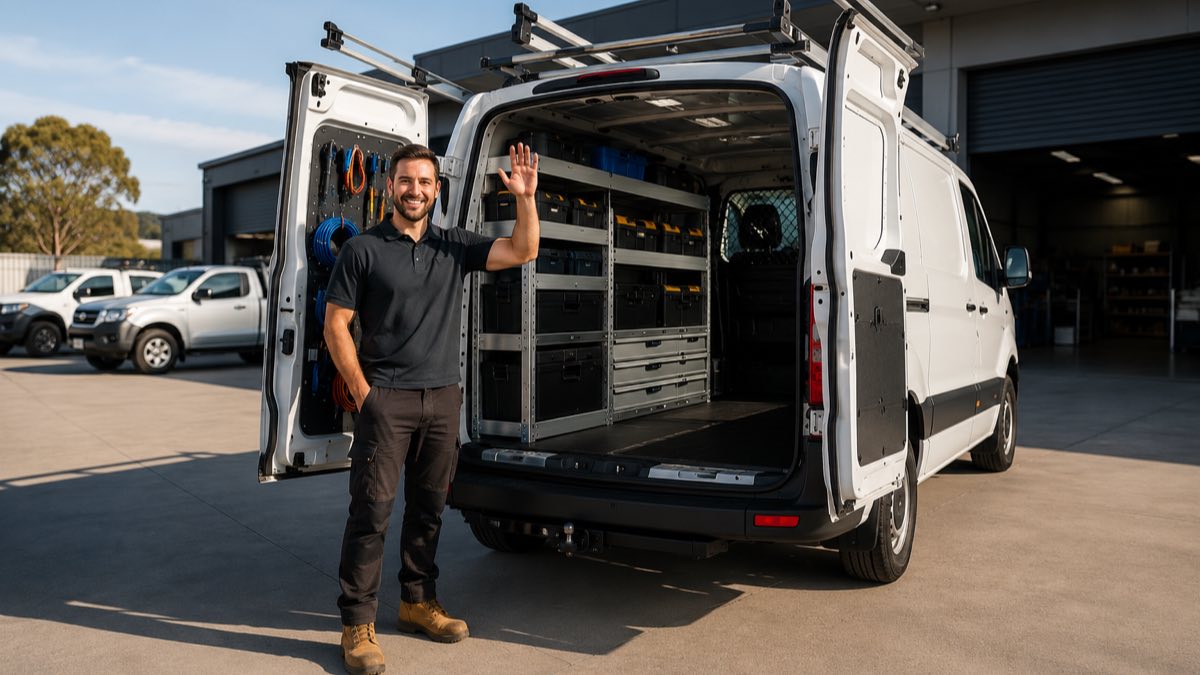
In short
- Be deliberate about what stays in the vehicle - everyday essentials, occasional equipment and job-specific gear.
- Work out how you'll use storage before buying shelves and drawers. Accessibility matters as much as capacity.
- Accessories add weight. Check GVM, payload and axle limits, and restrain loads properly.
- Make frequently used and heavy equipment easy to reach to reduce unnecessary lifting and bending.
- A simple restocking routine keeps a well-organised vehicle that way.
You’ve arrived at a customer’s house, opened the back of your van and realised the fitting you need is somewhere underneath three toolboxes.
You were sure you packed it.
After a few minutes of searching, you find it in a container behind the equipment you used yesterday. By the time you’ve put everything back, you’ve lost another five minutes.
It doesn’t sound like much. But when you’re visiting several jobs a day, those little delays can add up.
For electricians, plumbers, carpenters and mobile service technicians, a work vehicle is much more than a way to get from one job to another. It’s where tools are stored, materials are carried and a good part of the working day begins and ends.
Yet plenty of thought goes into choosing the right vehicle, while surprisingly little goes into deciding how it will actually be used.
A bigger van won’t necessarily solve poor organisation. Neither will filling every available space with shelves and drawers.
Getting the setup right starts with understanding what you carry, what you use most often and what slows you down.
Here are five mistakes worth looking out for.
1. Packing everything you own instead of everything you need
It’s tempting to carry every tool and spare part you might possibly need.
After all, nobody wants to arrive at a job and discover they’ve left something behind.
But there’s a difference between being prepared and carrying so much equipment that you can’t find anything.
Consider a plumber who handles routine maintenance, emergency repairs and occasional larger installations.
The tools needed for a leaking tap are different from those required for a major drainage job. Yet if every piece of equipment is carried every day, the vehicle can become crowded with items that are rarely touched.
The same problem occurs with electricians who carry specialised equipment for jobs they only undertake occasionally.
More equipment can mean more weight, less usable space and more things to move whenever you need something.
A better way to organise your gear
Start by separating your equipment into three groups.
- Everyday essentials: Tools and consumables used at most jobs. These should have dedicated, easily accessible locations.
- Occasional equipment: Items needed regularly but not every day. Give them secure storage without allowing them to obstruct more frequently used tools.
- Job-specific equipment: Tools and materials required for particular work. Where practical, load these according to the scheduled jobs rather than carrying everything permanently.
Of course, emergency service businesses may need a broader range of equipment readily available. The right balance depends on the type of work and the response times customers expect.
The point is to be deliberate about what stays in the vehicle.
Try this: At the end of the week, look at the tools you haven’t touched. Are they essential emergency equipment, or are they simply taking up valuable space?
You may discover that rearranging what you already own makes a bigger difference than purchasing additional storage.
2. Buying shelves and drawers before working out how you’ll use them
There are plenty of vehicle storage products available, from basic toolboxes to elaborate shelving and drawer systems.
The problem starts when someone purchases a storage system because it looks impressive, without considering how they’ll work around it.
Imagine installing large drawer units across the rear of a ute.
They provide plenty of organised storage. But once the tools are loaded, you discover that the equipment you use most often sits in a drawer that’s awkward to reach when parked near a wall or another vehicle.
Technically, everything fits.
Practically, the arrangement makes your working day harder.
Start with your daily routine
Before spending money on storage equipment, think about the work you carry out.
An electrician might want small fittings and frequently used hand tools near the side door.
A carpenter may need clear space for saws, power tools and lengthy materials.
A mobile service technician might prioritise secure compartments for diagnostic equipment and spare parts.
These businesses could operate identical vans and still need completely different layouts.
Accessibility matters just as much as storage capacity.
You should also consider the size and weight of equipment, door clearances, safe mounting points and how the storage arrangement will work when the vehicle is fully loaded.
There’s no rule saying every work van needs a complete shelving system.
For some businesses, properly secured storage containers and a sensible tool arrangement are enough.
Others may benefit from dedicated compartments, drawers or more specialised equipment.
Before purchasing anything, try making a list of the ten items you retrieve most frequently.
Then look at where they currently sit.
If reaching them involves shifting several other items, you have a problem worth solving.
And you don’t necessarily need an expensive solution.
3. Forgetting that all those accessories add weight
A vehicle can look half-empty and still be carrying too much weight.
It’s an issue worth checking when adding canopies, toolboxes, drawers, shelving, roof racks or other equipment to a commercial vehicle.
Every accessory contributes to the vehicle’s overall weight.
So do the driver, passengers, tools, materials and everything else carried on board.
A vehicle’s Gross Vehicle Mass (GVM) is the maximum permitted mass of the fully loaded vehicle. Payload is the weight the vehicle can carry within that limit. When accessories are added, they use some of the capacity that would otherwise be available for tools, materials and people.
For example, installing a heavy storage arrangement may leave less carrying capacity for the equipment needed on a normal working day.
Vehicle owners should also pay attention to front and rear axle limits, not just the vehicle’s overall GVM.
A tidy load isn’t necessarily a safe load
Weight is only part of the issue.
Loose equipment can move during sudden braking or a collision, even when the vehicle looks reasonably organised.
A toolbox sitting neatly on a shelf isn’t necessarily properly secured.
The National Transport Commission’s Load Restraint Guide for Light Vehicles provides guidance on safely transporting loads in vehicles such as vans and utes with a GVM of up to 4.5 tonnes. It covers load restraint and the need to prevent loads from creating a danger on the road.
Before adding significant equipment, check the vehicle’s approved mass limits and its actual loaded weight. Make sure storage fittings and restraints are suitable for the loads they’ll carry.
Roof-mounted equipment needs particular attention. The vehicle and rack ratings, secure attachment and applicable rules for protrusions all matter.
If you’re unsure whether a modification requires certification, check the requirements before proceeding.
The practical lesson: Don’t judge how much more your vehicle can carry simply by looking at the available space.
A vehicle can have plenty of room left but very little legal payload remaining.
4. Making loading and unloading harder than it needs to be
Think about the heaviest piece of equipment you carry regularly.
Where is it stored?
Can you get it out without first removing everything around it?
Now consider how often you perform that task.
For a business handling multiple jobs each day, the position of frequently used equipment can make a noticeable difference.
A mobile mechanic might regularly remove a heavy equipment case.
A plumber may carry awkward tools that are difficult to reach when buried inside the vehicle.
An electrician might repeatedly retrieve ladders from a roof-mounted rack.
The task itself may be unavoidable, but unnecessary lifting, reaching and repositioning can sometimes be reduced.
SafeWork NSW identifies repeated movements, awkward postures and high or sustained force among the factors that can make manual tasks hazardous.
This makes equipment access an important consideration when organising a work vehicle.
Look at the job from the worker’s position
Instead of concentrating only on how much equipment fits inside the vehicle, look at how someone will remove it.
- Can frequently used items be reached without excessive bending or stretching?
- Does the worker need to move heavy objects to access lighter ones?
- Are loading aids or mechanical assistance appropriate for particularly awkward equipment?
- Are the side and rear doors being used effectively?
Some businesses may benefit from sliding storage arrangements or suitable loading aids. Others might achieve a practical improvement simply by moving equipment to a more accessible position.
The important point is that any equipment or modification must be appropriate for the task, securely installed and used within its rated capacity.
For employers operating multiple work vehicles, it’s also worth asking employees what they find difficult.
A storage arrangement that makes sense on paper may be frustrating for the person using it every day.
Before changing the layout, ask the people doing the work.
Their feedback may reveal problems that aren’t obvious when the vehicle is parked and empty.
5. Having no system for restocking and keeping the vehicle organised
Even a thoughtfully organised work vehicle can become cluttered within a few weeks.
A new tool gets purchased and left wherever there’s room.
A box of fittings is opened and never returned to its original compartment.
Materials from a finished job remain in the back because nobody has had time to remove them.
Before long, the original arrangement has disappeared.
This isn’t always a storage problem. Often, it’s a routine problem.
Consider an electrician who regularly carries connectors, screws, cable accessories and other small consumables.
Everything might be neatly organised at the beginning of the month.
But if nobody checks the quantities, the electrician may eventually arrive at a job without a commonly used fitting.
That can mean an unnecessary trip to a supplier, an interrupted job or a return visit.
Having more storage compartments won’t automatically prevent that situation.
Make restocking part of the working week
A simple routine can help.
- Keep regularly used consumables in clearly labelled locations and establish sensible minimum stock quantities.
- When supplies run low, replenish them before the next job rather than waiting until they’re completely exhausted.
- Return tools to their proper locations at the end of the day.
- Remove unnecessary packaging, leftover materials and equipment that no longer needs to remain in the vehicle.
- Periodically check storage fittings, restraints and other accessories for signs of wear or damage.
For businesses with several employees, a consistent system can make it easier for workers to locate shared equipment.
It doesn’t have to be complicated.
A labelled container and a short restocking checklist may be more useful than an elaborate inventory system nobody maintains.
Leave room for the business to change
Today’s setup may not suit the jobs you’re doing in another year.
A sole trader may eventually employ another technician, purchase different equipment or expand into a new type of work.
When planning storage, think about whether the arrangement can accommodate reasonable changes.
That doesn’t mean leaving half the vehicle empty indefinitely.
It means avoiding a design that’s so rigid or crowded that every new piece of equipment creates another problem.
A little planning can save unnecessary rearranging later.
What does poor vehicle organisation actually cost?
It’s easy to dismiss a few minutes spent looking for tools.
But small delays become more noticeable when they happen repeatedly.
Let’s use a simple example.
Suppose a tradesperson spends an extra four minutes searching for equipment at three jobs each day.
That’s 12 minutes a day, or one hour across a five-day working week.
Over 48 working weeks, that would amount to 48 hours.
This is only an illustrative calculation, not an estimate of the time most Australian tradespeople lose.
Your actual experience may be very different.
Still, it’s worth asking whether avoidable time spent searching for tools could be used for productive work, preparing for the next job or finishing the day on schedule.
Missing materials and extra supplier trips can create further delays.
Not every minute saved becomes additional revenue. But reducing unnecessary interruptions can help make the working day more predictable.
And when a small business is trying to fit several appointments into one day, predictability matters.
Try this before spending money on a vehicle fitout
You don’t have to replace your vehicle or purchase expensive storage equipment to find out whether your current arrangement could work better.
Choose a normal working day and pay attention to what happens every time you open the van or ute.
At the end of the day, ask yourself:
- Which tools did I spend the most time looking for?
- Did I have to move unnecessary equipment to reach something?
- Was there anything I carried all day but didn’t need?
- Were any items difficult to lift, retrieve or secure?
- Did I run out of supplies that should have been stocked?
Make a note of the answers.
Then identify what can be improved immediately and what might require a different storage arrangement.
Safety concerns, including inadequate load restraint or overloading, need to be addressed promptly rather than left for a future upgrade.
Other improvements can often be made gradually.
Try reorganising a few items, using better labels or changing the way equipment is prepared for each job.
Give the changes a fair trial before deciding whether additional equipment is necessary.
A better workday starts with a better setup
For most tradespeople, the goal isn’t to have the most impressive-looking van or ute on the road.
It’s to arrive at a job with the right equipment, find what you need and get on with the work.
A practical vehicle setup helps make that possible.
Sometimes that means installing better storage equipment. Sometimes it means removing unnecessary gear, improving load restraint or introducing a simple restocking routine.
There isn’t one layout that works for every electrician, plumber, carpenter or mobile service business.
The best approach is to start with the work itself.
Look at what you carry, how often you use it, how safely it can be transported and where time is being wasted.
Then make changes that solve those problems.
After all, customers are paying for the job you’ve come to do, not the time you spend searching through the back of your van.
About the author
Anthony Nazari is the founder and Sales Manager of Fleet Fitout, a Sydney-based business specialising in commercial van and ute fitouts, storage systems, shelving, canopies and automotive accessories. Fleet Fitout helps Australian tradespeople and businesses plan practical vehicle setups suited to their daily work.
Common questions
How should a tradie organise a work van?
Start by separating equipment into everyday essentials, occasional equipment and job-specific gear. Give everyday items dedicated, easy-to-reach locations, and load job-specific equipment according to the scheduled jobs rather than carrying everything permanently.
What is GVM and why does it matter for a work vehicle?
Gross Vehicle Mass (GVM) is the maximum permitted mass of the fully loaded vehicle. Payload is what the vehicle can carry within that limit. Canopies, drawers, shelving and racks use some of that capacity, so check approved mass limits, axle limits and the vehicle’s actual loaded weight.
Where can I find guidance on restraining loads in a van or ute?
The National Transport Commission’s Load Restraint Guide for Light Vehicles gives guidance on safely restraining loads in light vehicles, which it defines as vehicles with a gross vehicle mass up to 4.5 tonnes. You must also follow the load restraint laws in your state or territory.
Do vehicle accessories need certification?
Some do. If you’re unsure whether a modification or accessory requires certification, check the requirements in your state or territory before proceeding. In NSW, the government suggests speaking to a licensed certifier before you buy if you’re unsure.